
 You’ve been living with chronic pain long enough that surgery is starting to sound reasonable. Maybe even necessary.
The orthopedist at the base clinic showed you the imaging. Explained what they’d need to do. Talked about recovery times and physical therapy protocols. And you’re sitting there thinking about what surgery actually means for your career, your family, and your ability to serve.
Here’s what 13 years of treating military personnel in Virginia Beach has taught me: surgery has its place. Some injuries absolutely require surgical intervention. But the majority of chronic pain conditions that sideline tactical athletes respond to conservative treatment when that treatment actually addresses the underlying tissue damage.
Shockwave therapy is that treatment. And before you commit to a surgical procedure with months of recovery, career implications, and no guarantee of return to full function, you owe it to yourself to understand what non-surgical options can actually do.
What Surgery Really Means for Active Duty Service Members
Let’s be honest about what you’re signing up for when you choose surgery:
You’re looking at weeks or months of limited duty status. Depending on the procedure, you might be on medical hold for 3-6 months before you’re cleared for full activity. That’s months away from your team, your training, your operational tempo.
There’s physical therapy. Lots of it. Which is necessary for surgical recovery, but it’s also time-consuming and doesn’t always get you back to 100% function.
There’s risk. Every surgical procedure carries risks of infection, complications, failed outcomes, and the possibility that the surgery doesn’t solve the problem you’re trying to fix.
And then there’s the career piece. Medical evaluations. Fitness for duty assessments. The possibility that recovery doesn’t go as planned and you’re looking at limited duty or medical separation.
For some injuries, that’s worth it. For many chronic pain conditions, it’s not necessary.
How Shockwave Therapy Works Differently
Shockwave therapy isn’t just another conservative treatment to try before surgery. It’s a different approach entirely.
Traditional conservative care (rest, ice, NSAIDs, physical therapy) focuses on managing symptoms while hoping tissue heals on its own. That works for acute injuries where blood flow is good and the body’s healing response is intact.
But chronic pain conditions develop because tissue isn’t healing properly. Blood flow to the area has decreased. Scar tissue has formed. Inflammation has become chronic rather than acute. And the normal healing cascade has stalled out.
Shockwave therapy restarts that healing cascade.
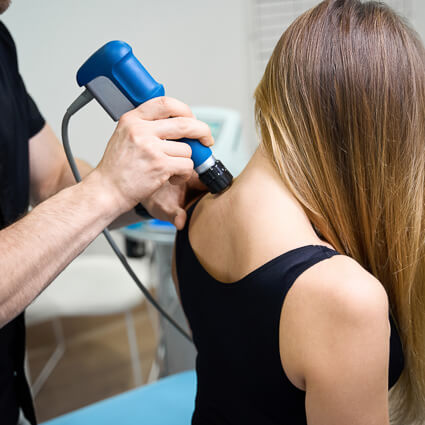
The acoustic waves trigger neovascularization, which means new blood vessels form in areas where circulation has been compromised. They stimulate collagen production so tendons and ligaments can rebuild properly. They break up scar tissue and adhesions that have been restricting movement. They interrupt chronic inflammation patterns. And they release trigger points that have been causing pain and dysfunction.
The result is tissue that actually heals instead of just existing in a state of chronic dysfunction.
Conditions That Respond to Shockwave Instead of Surgery
At our Virginia Beach locations near Little Creek and Oceana, we’re successfully treating conditions that often get surgical recommendations:
Rotator cuff tendinitis and tendinosis. These respond incredibly well to shockwave therapy because we’re addressing the actual tendon damage and promoting proper healing. Many rotator cuff surgeries are performed for tendon issues that could have been resolved conservatively.
Chronic knee pain from patellar tendinitis, IT band syndrome, and even early degenerative changes. We’re not regenerating cartilage, but we’re addressing the soft tissue dysfunction that causes most knee pain and limited mobility.
Plantar fasciitis. This is one of the most researched conditions for shockwave therapy, with success rates consistently above 80%. Surgery for plantar fasciitis has significant risks and extended recovery times. Shockwave gets the same result without cutting.
Tennis elbow and golfer’s elbow (lateral and medial epicondylitis). These chronic tendon conditions respond well to shockwave because we’re triggering actual healing in tissue that’s been stuck in a dysfunctional state.
Hip and glute pain from tendinitis, bursitis, and trigger points. Conservative treatment often fails for these conditions because it doesn’t address the underlying tissue damage. Shockwave does.
Chronic lower back pain when it’s coming from soft tissue dysfunction rather than structural issues requiring surgical intervention.
Neck pain and shoulder compression from helmet weight and chronic postural dysfunction.
Real Outcomes from Real Service Members
I’ve treated special operations personnel who were scheduled for surgery and cancelled it after seeing results from shockwave therapy.
One Navy SEAL from Little Creek was scheduled for shoulder surgery for chronic rotator cuff tendinitis that hadn’t responded to six months of physical therapy. He decided to try shockwave as a last attempt before going under the knife. After four treatments, his pain had decreased by 70%. After eight treatments, he was back to full training and cancelled the surgery. That was two years ago, and he’s still operational without surgical intervention.
Another service member from Oceana had been dealing with chronic Achilles tendinitis for three years. He’d tried everything short of surgery and was being told that surgical debridement was his next step. Six shockwave treatments resolved the issue completely. No surgery. No extended recovery. Back to full duty within weeks instead of months.
These aren’t miracle stories. This is what happens when you address tissue damage at a cellular level and give your body the signal to actually heal.
The Treatment Timeline Comparison
Let’s compare timelines for surgical vs. shockwave treatment:
Rotator cuff surgery: 4-6 months recovery before full activity. Physical therapy 2-3 times per week. Months of limited duty.
Shockwave therapy for rotator cuff tendinitis: 6-8 treatments over 3-8 weeks. Minimal downtime between treatments. Most patients back to full activity within 2-3 months.
Knee arthroscopy: 6-12 weeks recovery. Physical therapy protocol. Gradual return to full activity.
Shockwave therapy for chronic knee pain: 6-8 treatments over 3-8 weeks. Most patients report significant improvement within first few sessions. Return to full training progressively throughout treatment.
The difference isn’t just time. It’s risk, career impact, and quality of outcome.
When Surgery Is Actually Necessary
I’m not anti-surgery. Some conditions require surgical intervention, and shockwave therapy isn’t a replacement for necessary procedures.
Acute tears (complete rotator cuff tears, ACL tears, severe meniscus tears) often need surgical repair, particularly in tactical athletes who need to return to high-level function.
Structural issues like severe spinal stenosis, significant disc herniations with neurological deficits, or advanced joint degeneration might require surgical correction.
Fractures, dislocations, and traumatic injuries generally need surgical stabilization.
But here’s the key: most chronic pain conditions aren’t structural. They’re functional. The tissue has broken down, but it’s still intact. It’s just not healing properly.
Cost Considerations
Surgery is expensive. Even with Tricare coverage, you’re looking at copays, time off, potential loss of special duty pay during recovery, and the indirect costs of extended time away from your team and your mission.
Shockwave therapy is typically a fraction of the cost of surgical intervention. And because you’re not losing months of duty time, the indirect financial impact is significantly less.
But beyond cost, there’s the value of staying operational. Of not missing deployments. Of not being separated from your team during critical training cycles. Of maintaining the career trajectory you’ve worked for.
What Military Families Need to Know
When your service member is facing surgery, it impacts your entire family. Months of recovery means limitations on what they can do at home. Physical therapy appointments multiple times per week. Potential changes in duty station or assignment if recovery takes longer than expected.
And military spouses deal with chronic pain too. From managing households during deployments, from carrying kids and gear, from the physical demands of keeping everything running while your partner is gone. Surgery often isn’t a viable option because you can’t take months off from parenting and household management.
Shockwave therapy works for military families because it doesn’t require that kind of downtime. You come in for treatment, you go back to your life. The effects build over multiple sessions, but you’re not sidelined from daily activities.
Making the Decision
If you’re considering surgery for chronic pain, ask yourself these questions:
Have you tried treatment that actually addresses tissue damage at a cellular level, or just symptom management?
Have you given your body the signal it needs to restart the healing process?
Do you understand the full career implications of surgical recovery time?
What’s your timeline for needing to be back at full operational status?
Are you willing to try a non-surgical option that has strong evidence for the condition you’re dealing with?
If surgery is truly necessary, it will still be an option after trying shockwave therapy. But once you have surgery, you can’t go back and try conservative treatment first.
Next Steps
If you’re dealing with chronic pain and surgery has been mentioned as the next step, don’t make that decision without exploring what shockwave therapy can do.
We work with military personnel from Little Creek and Oceana Naval Base who need solutions that fit their operational tempo and career demands. We understand that downtime isn’t just an inconvenience for you. It affects your team, your mission readiness, and your career trajectory.
Shockwave therapy gives you an option that addresses tissue damage without the knife, without months of recovery, and without the career implications of extended medical hold status.
Located in Virginia Beach at Shore Drive and Landstown Commons, minutes from Little Creek and Oceana Naval Base. Call Wave of Life Chiropractic to schedule your evaluation and find out if shockwave therapy can resolve your chronic pain without surgery.
CONTACT US